Tell us about the job
Takes about a minute. No obligation.
A furnace contractor working a repair call in Prentiss County starts at the burner assembly and the ignition system, because that is where the accumulated cycling shows up. Homes in Prentiss County, MS run heat about seven months a year, from October through April. The heat exchanger cracks, the igniter wears, and the flame sensor fouls under that kind of repeated use. A system that was installed close to its limits will have been running harder than a properly sized one, and the parts tell the story plainly once the cabinet is open.
Half the homes in Prentiss County, Mississippi were built in 1981 or earlier (2020-2024 ACS 5-year). Furnaces running in houses that old often pre-date the parts lines a supply house stocks today. When a contractor opens a unit here, the question is not always whether the fix is straightforward but whether the component it requires is still made or has been superseded by something that does not fit the same mount. That gap between what the system was built around and what distributors carry now is what shapes the repair scope and the timeline.
The Parts of a Furnace a Contractor Checks First
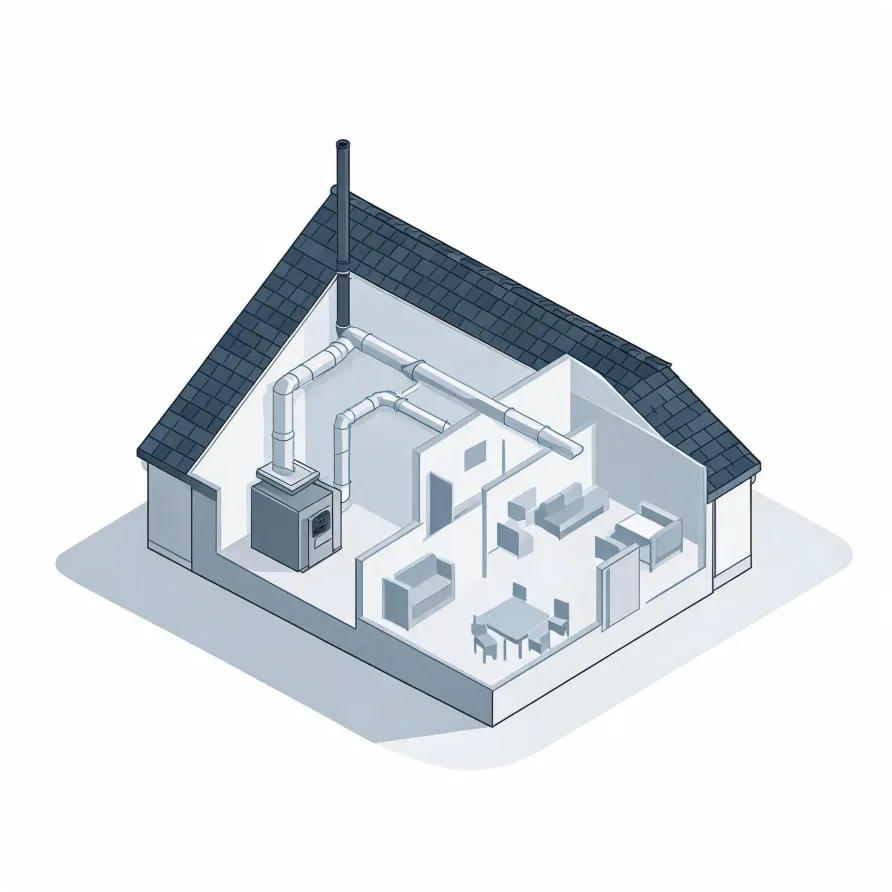
The heat exchanger sits at the core of the furnace cabinet, usually in a utility room, basement, or closet. It is the first place a contractor looks when a furnace is running but not heating, because cracks or blockages there stop the system from doing its job. The burner assembly sits just below it and is the second suspect when ignition fails or the flame cuts out early.
The blower motor and its wheel sit in the lower half of the cabinet and push conditioned air out through the supply plenum into the house. The control board, mounted inside the same cabinet, reads signals from the thermostat and tells every other component when to run. When a furnace behaves erratically or shuts itself down, one of those two pieces is usually where the contractor starts.
The drawing shows a representative layout, and a licensed contractor determines which components apply to the specific furnace and setup in your home.
Find a contractor in Prentiss CountyPrentiss County, by the numbers
65 severe weather events were recorded in Prentiss County, Mississippi between 2015 and 2024.
NOAA National Centers for Environmental Information, Storm Events Database, bulk CSV export, events 2015-01-01 through 2024-12-31.Half the homes in Prentiss County, Mississippi were built in 1981 or earlier (2020-2024 ACS 5-year).
U.S. Census Bureau, 2020-2024 American Community Survey 5-Year EstimatesPrentiss County, Mississippi holds 11,050 housing units (2020-2024 ACS 5-year).
U.S. Census Bureau, 2020-2024 American Community Survey 5-Year EstimatesOwners occupy 77.5% of the occupied homes in Prentiss County, Mississippi (2020-2024 ACS 5-year).
U.S. Census Bureau, 2020-2024 American Community Survey 5-Year EstimatesFurnace Repair Rules on the Books for Prentiss County, Mississippi5 sourced standards and codes
What Happens When the Contractor Shows Up
Non-weatherized gas furnaces manufactured on or after November 19, 2015 must reach 80.0 percent AFUE.
Non-weatherized oil-fired furnaces manufactured on or after November 19, 2015 must reach 83.0 percent AFUE.
Mobile home gas furnaces manufactured on or after November 19, 2015 must reach 80.0 percent AFUE.
Non-weatherized gas furnaces manufactured on or after December 18, 2028 must reach 95.0 percent AFUE, up from the 80.0 percent minimum that applies to units manufactured before that date.
Licensing Rules for HVAC Repair in Prentiss County, Mississippi
Mississippi licenses residential HVAC work at every tier and at any price: a subcontractor of any tier doing heating, ventilation or air conditioning work on a residential construction or improvement project must be licensed by the State Board of Contractors no matter the dollar amount.
Severe Weather Events in Prentiss County
Hard weather puts real load on furnace systems. Repeated stress from power fluctuations, temperature swings, and pressure changes shortens the life of components and raises the odds that something fails when the heat is needed most.
65 severe weather events, 2015–2024. Source: NOAA National Centers for Environmental Information, Storm Events Database.